


Quick Answer: In the Disney+ mobile app or a supported browser, open Edit Profiles, select the child’s profile and choose Content rating, or use Junior Mode for an all-ages selection. PIN-protect less-restricted profiles and restrict new profile creation separately. Check the unrated/live-content setting too; a maturity rating alone is not a complete household boundary.
Disney Plus parental controls are profile controls, not a promise that every viewer will stay in the right profile or that every programme suits your family. Disney’s library also includes entertainment intended for adults. The useful question is which profile and access route your child can actually use on the television, phone or tablet.
I appreciate having separate family profiles, but I would not stop after choosing a child’s avatar. This guide explains the rating and Junior Mode choices, adult-profile PINs, account-password protection, time-management limits and recovery steps. The instructions preserve the difference between selecting content and controlling access.
Understand what each Disney+ control does
A content rating limits rated titles available through that profile. A Profile PIN controls entry to a profile. Profile creation restriction controls whether someone can make another profile. These settings work together; they are not interchangeable names for the same password.
Use the diagram as an access check. If the child’s own profile has a suitable rating but an unrestricted adult profile opens without a PIN, adjusting the child’s rating again will not close that route. If a new profile can be created, protect profile creation as well.
How to change Disney Plus parental controls
Use the mobile app or a supported browser to manage the parental settings. A TV may let you choose profiles, but a phone or browser is the clearer place to review all the controls. Keep the account holder’s password private and select the exact profile you mean to change.
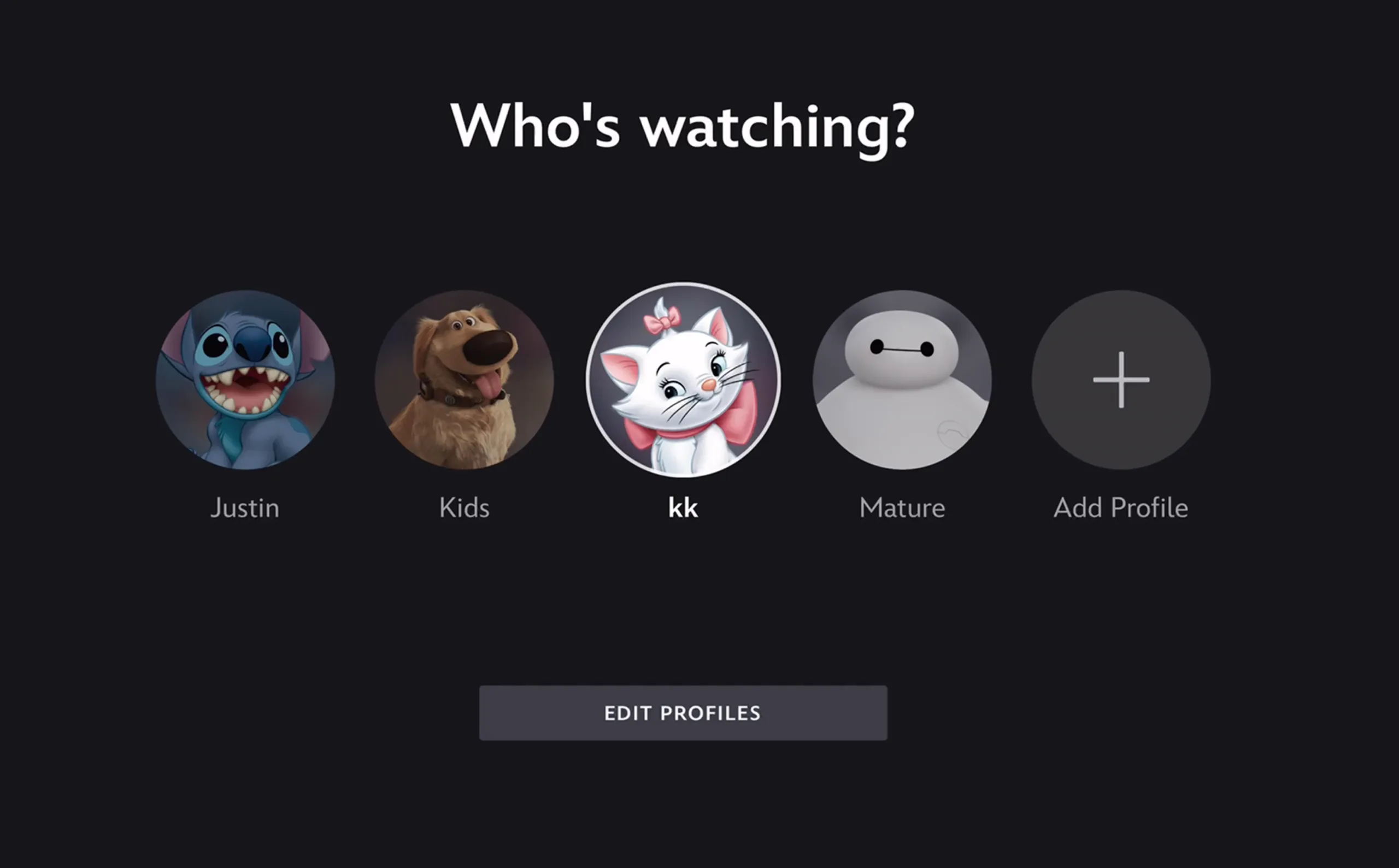
1. Create or choose the child’s profile
Open the profile selector and choose Add Profile if the child needs a separate profile. Choose an avatar, enter a recognisable name and review the parental choices shown before saving. Use a distinct name for each household member so that shared-TV mistakes are easier to spot.
For an existing profile, choose Edit Profiles and select that profile. Do not assume the primary account profile is already child-restricted. Disney’s US guidance says the primary profile and profiles associated with an adult date of birth default to the highest TV-MA rating.
2. Choose a content rating or Junior Mode
- Open Edit Profiles and select the profile you want to change.
- Under Parental Controls, choose Content rating.
- Enter the account password when requested.
- Choose the appropriate available rating and save the change.
Choose from the ratings shown for your account and region. US examples include TV-Y, TV-Y7, TV-G, TV-PG, TV-14 and TV-MA, alongside film classifications. A rating is a classification threshold, not a personalised judgment of your child’s readiness for every theme. Read the programme’s description and content information when a particular subject matters.
Disney says titles above the selected rating are excluded from profile browsing and search, but content included in on-service promotions is not governed in the same way. Review what the child actually sees on the devices they use, including promotional areas, rather than promising that every adult reference disappears.
When Junior Mode is the better choice
Junior Mode offers a simpler, ad-free selection intended for all ages. You do not set a custom maturity rating inside Junior Mode. If your goal is a tailored rating threshold for an older child, use a regular profile with that rating instead.
To change an existing eligible profile, open Edit Profiles in the app or browser and switch Junior Mode on. Disney says the primary profile cannot use Junior Mode. Turning Junior Mode off requires the account password. Review the resulting rating afterward rather than assuming the previous child-friendly selection remains.
Kid-Proof Exit adds a challenge before leaving Junior Mode. It is intended for younger viewers and is different from the four-digit PIN protecting an adult profile. A child who can complete the exit challenge may still reach the profile selector; protect less-restricted profiles separately.
3. Protect access to other profiles
Set a Profile PIN on every profile that gives access to content you do not want the child to choose independently. In Edit Profiles, select the relevant profile, open Profile PIN under Parental Controls and follow the password and PIN instructions shown.
A four-digit Profile PIN is not a separate Disney+ account password, and there is no universal default code families should use. Choose your own code, avoid an obvious shared birthday and keep account-password recovery under the account holder’s control.
Then review profile creation restriction on the Account page. When enabled, Disney requires the account password to create a new profile. This closes a different route from an adult-profile PIN. After saving, review the profile selector together and confirm which profiles the child should use.
Check unrated programmes, live content and bundles
Do not assume every live programme has a maturity rating. Disney’s current guidance includes an “Allow titles without ratings like live sports, news, and more” setting; another regional label may be “Not Rated & Live Content.” Review that setting on the child’s regular profile, especially if you want to exclude unrated live material.
Disney says this option is normally on by default outside Junior Mode. Live programmes and live advertising may contain mature themes or products. Turning the option off addresses the specified unrated/live categories; it is not a general title-by-title blacklist.
For US subscribers with eligible bundles, Disney+ profile ratings also affect Hulu content watched inside Disney+. Rated ESPN content follows the profile’s rating, while the unrated/live choice remains important for material without ratings. Availability and labels vary by subscription and country.
Treat a standalone app or another service as a separate setup task. A Disney+ profile should not be assumed to configure every Hulu, ESPN or other streaming login on the device. Check each actual service and profile the child can open.
Password protection and screen-time limits
Keep the Disney+ account password separate from Profile PINs. The password authorises account and parental-setting changes; the PIN is a narrower barrier at a profile. Giving a child the account password can undermine the access arrangement even if you originally set a strong PIN.
Disney+’s current profile controls manage content and profile access; they do not include a daily viewing allowance with automatic logout. Use a device-level timer when you need an enforced limit. Autoplay is a playback preference, not a viewing allowance.
For a time limit, use the supported controls on the actual device or a household routine. Apple Screen Time and Google Family Link can provide supported device or app limits, while a connected TV may need its own manufacturer settings. A phone’s limit does not automatically cover the television.
Turning autoplay off can make an agreed stopping point easier to follow. Pair that choice with a realistic rule such as finishing one episode together, rather than describing autoplay as an enforcement tool. Check whether an app limit is a reminder or a block and how extra-time requests are handled.
Troubleshoot ratings, missing programmes and forgotten PINs
A programme is missing or the rating seems wrong
- Confirm that the device is using the intended profile. Switching profiles changes the applicable choices.
- Review Junior Mode, the saved maturity rating and the unrated/live setting in the mobile app or browser.
- Check that the title is included in the current subscription and region. A parental-setting change does not purchase access to a programme.
- Save the intended change and return to that profile on the viewing device. If the app is stale, restart or update it and check again.
- If the result still contradicts the saved settings, record the title, profile and device and use Disney+ support. Avoid permanently raising the rating just to troubleshoot.
There is no need to relax every profile because one programme is absent. If a parent decides a specific programme is appropriate, watch together using the parent’s protected profile, then return to the child’s profile. That is an intentional supervised choice, not a claim that Disney+ offers a per-title exception list.
Forgotten Profile PIN or account password
Use the Forgot PIN or recovery instructions shown by Disney+ and verify the account holder’s credentials when requested. If the account password is also unavailable, start with the official account sign-in recovery flow and the account holder’s email. Never send a code or password to a third-party “unlock” service.
PIN recovery and password recovery solve different problems. After recovering access, review the selected profile’s controls and other less-restricted profiles. Do not disable the whole family setup just because one adult needs access again.
Relax or remove a restriction deliberately
An authorised account holder can change a rating, turn Junior Mode off or remove a Profile PIN through the relevant setting. Make one change at a time, save it and review the result. Removing one setting does not necessarily remove all other restrictions, subscription limits or regional availability rules.
My preference is to agree the reason for a change with the child and set a date to review it. A higher rating should follow a family decision about the content, rather than becoming the permanent answer to a technical fault.
My recommendation
Start with a separate child profile, choose Junior Mode or an appropriate rating, and protect the other profiles and profile-creation route. Review unrated/live content before handing over a shared television. For viewing time, use the device’s real controls and an agreed routine. This creates a clearer boundary than relying on the Disney brand or a single PIN.
Frequently asked questions
How do I set up parental control Disney Plus?
Create or choose the child’s profile in the Disney+ app or a supported browser. Select Junior Mode for an all-ages selection or choose a content rating on a regular profile. Protect less-restricted profiles with PINs, restrict new profile creation and review unrated/live content separately.
What age rating options are available on Disney Plus parental control?
The available classifications depend on the country and account. US examples include TV-Y, TV-Y7, TV-G, TV-PG, TV-14 and TV-MA, with film classifications also shown. Use the choices displayed for your profile. Junior Mode does not offer a custom rating threshold.
How can I change the content rating on Disney Plus?
Open Edit Profiles, select the profile, choose Content rating under Parental Controls, enter the account password when requested, select the intended rating and save. If the profile is in Junior Mode, decide whether to keep that all-ages selection or deliberately move to a regular profile.
What is the PIN code for parental controls on Disney Plus?
A Profile PIN is a four-digit code chosen by the account holder to control access to that profile. It is different from the account password and Junior Mode’s exit challenge. There is no universal PIN to use; follow Disney’s official recovery flow if you forget yours.
Can I turn off parental controls on Disney Plus parental control settings?
An authorised account holder can change individual settings such as the rating, Junior Mode or a Profile PIN. Removing one restriction does not necessarily remove the others. Review the resulting profile, live-content choice and access to other profiles before a child uses it.
Is there a way to block specific shows or movies on Disney Plus?
Disney’s current documented profile controls do not provide a title-by-title blacklist. Use the supported content rating or Junior Mode choices, and review the unrated/live setting. A rating threshold may also exclude other titles at the same maturity level; it is not an individual programme block.
Sources and image credits
Primary guidance checked 9 November 2026: Disney+ parental-controls guide (revised 13 May 2026), parental controls (27 October 2026), Junior Mode (24 June 2026), profile management and missing-content guidance. Device limits: Family Link app controls and Apple Screen Time schedules.
Profile-selection example: Disney+, from its official guide. Featured illustration: Impulsec/Koala. Profile-access diagram: Impulsec.
Share this article

Stuart Kerr Spindlow is Impulsec’s Publisher, Chief Editor and Lead Reviewer. He writes and maintains coverage of consumer cybersecurity and digital-safety software, with a focus on practical suitability, limitations and the evidence behind product claims. Read Stuart’s full profile.