


Bark Phone Review: Quick Verdict Device $15/month x24 + service from $29/month

Product Name: Bark Phone
Product Description: Samsung Android phone with integrated parental controls, parent-managed contacts and apps, and required US Bark Wireless service. Standard handset payments and wireless service are separate.
Brand: Bark
My verdict on Bark Phone
3.4/5. A useful managed first smartphone for US families who want parent-approved contacts and apps, staged access and supported content alerts. Standard handset installments start at $15/month for 24 months, plus service from $29/month. Alerts are not access to every message or an instant safety guarantee.
Overall
-
Family rule controls
-
Monitoring scope
-
Child-platform coverage
-
Setup requirements
-
Family privacy controls
-
Family plan value
Pros
- Integrated contact, app and routine controls
- Access can progress from Starter to Advanced
- Supported alerts with selected flagged content
- Parent management from iOS or Android
Cons
- Required US Bark Wireless service plus handset cost
- Starter has no app store or internet browsing
- Monitoring coverage varies; alerts are not instant or complete
- Device-only return terms; wireless payments are nonrefundable
This Bark Phone review covers a Samsung Android handset, Bark’s family controls and the required Bark Wireless plan. I would consider it when a child needs a first smartphone with parent-managed contacts, apps and routines, and the family wants those decisions built into the device. It is a more expensive commitment than setting rules on a phone you already own.
My experience of the dashboard has been positive: moving around it and adjusting rules felt straightforward. The useful buying question is whether that integrated approach solves your family’s problem. It does not make monitoring infallible, provide every private message, or replace a conversation with your child.
Who Bark Phone suits—and who should choose something else
Bark Phone makes most sense for a US household that wants to introduce phone access in stages. A younger child can begin with approved calls and texts; a child ready for more independence can use an Advanced service plan with parent-approved apps and browsing rules. Decide what the child actually needs for school, travel and family communication before choosing the plan.
I would be more cautious if you already have a suitable handset, need service outside the US, or want to keep an existing carrier plan. The Bark app is a separate bring-your-own-device option. Installing the parent app on an iPhone does not turn that iPhone into a Bark Phone or provide the same child-device controls.
The standard model and Bark Phone Pro are also different hardware purchases. This review’s cover shows Bark’s official Samsung A16 standard-model product image. Check the exact model and offer at checkout; do not transfer the Pro’s processor, memory or durability claims to the standard phone.
What is included, and what costs extra?
Bark’s pricing page, checked on 19 October 2026, separates the handset from service. Standard Bark Phone device payments are $15 a month for 24 months ($360 total). Pro device payments are $25 a month for 24 months ($600 total). Wireless service is additional.
For the standard phone, Starter service at $29 a month plus the $15 device payment begins at $44 a month during the installment term. Advanced service starts at $39 for Wi-Fi data access, making $54 with that same device payment. Cellular-data service options increase the total. A “from $29” service price should not be presented as the whole phone bill.
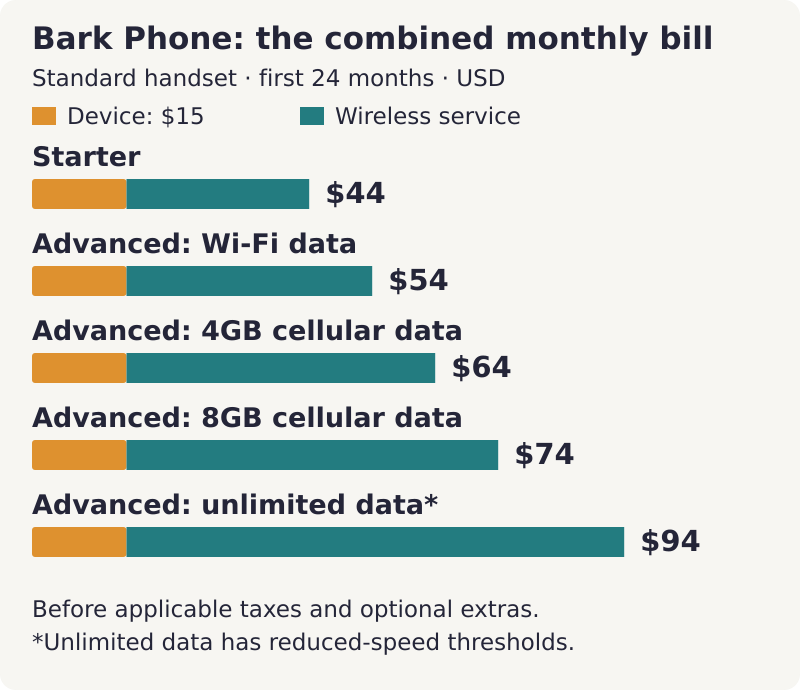
The current phone offer lists Advanced service at $49 with 4GB, $59 with 8GB and $79 with unlimited cellular data. Adding the standard handset payment gives $64, $74 and $94 a month respectively during the 24-month device term, before applicable taxes or other checkout charges. Unlimited data has reduced-speed thresholds; it does not mean unlimited full-speed use.
After the handset is paid off, the device installment ends; service remains a separate recurring charge under the then-current plan. Check coverage at the places your child uses the phone and review any optional protection plan separately. A device payment, wireless plan and optional insurance are three different costs.
Starter versus Advanced: choose access before features
Starter is deliberately restricted: approved talk and text without an app store, internet browsing or games. It is useful when the job is keeping in contact rather than handing over a fully open smartphone. Do not buy Starter expecting to install school, transport or messaging apps that require the Advanced setup.
Advanced makes more functions available, but parents still decide what to allow. The Wi-Fi-only data option is not equivalent to a cellular-data allowance away from Wi-Fi. Think about the school journey and other regular trips, then choose the smallest plan that supports the actual routine.
A sensible progression is to allow a small number of necessary contacts and apps first, review how they are used, and then adjust access. Starting with the most expensive data tier or the largest monitoring scope is not automatically the best family decision.
Contacts, calls and texts: practical rules and limits
Bark’s contact-management instructions, updated 27 July 2026, distinguish Starter’s required approved-contact setup from the configurable approval setting on Advanced. Parents can approve requests rather than giving every new number access immediately.
Plan a contact list before handing over the phone: parents, other caregivers and the people needed for ordinary school or travel arrangements. Check what happens to an unapproved number and a group conversation. Contact approval controls the communication rules; it is not an assurance that every approved contact or conversation is safe.

Bark uses its own Messages app on the phone to support contact rules and text-deletion controls. Its texting settings guide explains how the messaging app, texting limits and deletion permission are managed. Review these settings with the child rather than assuming that an app time limit and a contact rule do the same thing.
Keep an accessible way to reach a caregiver. When changing routines or app restrictions, check ordinary outgoing and incoming communication on the actual phone. Explain how the child can ask for a contact to be added and how the family will handle an incorrectly blocked conversation.
App approvals, daily limits and routines
The app-store controls let an Advanced-plan parent decide whether the Play Store is available and require approval for requested apps. An app waiting for approval remains unavailable until the parent acts. Starter keeps the store blocked.
Review the app itself before approving it. A school app, browser, chat service and game can each have their own account, content and privacy settings. Permission to download an app is not approval of everything that may happen inside it. Revisit the list when the child changes school or begins using a new service.
Bark’s daily-limit guide, updated 11 June 2026, describes individual app allowances and an all-apps allowance that excludes the Phone app. Limits reset at 3:30 a.m.; a warning appears shortly before time expires, and parents can make a temporary adjustment.

A daily allowance answers “how much time?” A routine answers “what is allowed at this time?” School and bedtime rules can therefore differ from a general daily budget. Check the result after changing either setting; otherwise a parent may extend a daily allowance while a scheduled rule still restricts an app.
The most useful rules are understandable ones. Explain the schedule, keep the necessary exceptions small, and agree how extra time will be requested. In my judgment, that is a better use of these controls than changing limits unpredictably or treating every app request as a problem.
Monitoring alerts are not a complete message reader
Bark’s text-message FAQ says parents receive alerts and selected flagged content when potential issues are detected. It does not provide access to every message. The company also says text alerts are not instantaneous because analysis takes time.
That corrects an important buying expectation. Bark can help identify selected concerning content in supported activity; it cannot promise that every harmful exchange will be found or delivered immediately. A notification is a prompt to understand the context, not a diagnosis or a complete account of what happened.
Coverage depends on the supported app or account and the setup described by Bark. An app’s presence on a marketing list does not establish identical monitoring across every version, media type or platform. Check the specific services your child uses, and keep normal direct communication available for concerns that an automated alert may miss.
Setup, parent devices and keeping the phone working
The Bark Phone setup guide begins with the supplied phone and the parent’s account. Follow the activation prompts, link the child profile, and configure the rules in the parent dashboard or app. Bark’s controls come installed on the child handset; this is not the same process as adding the standalone Bark app to an existing phone.
Parents can use Bark’s iOS or Android parent app. Bark explicitly supports an iPhone parent managing an Android child device. The child’s phone and the parent’s management device have different roles.
- Confirm Bark Wireless coverage and any number-porting requirements before ordering.
- Create or select the correct child profile, then review contacts, app availability, schedules and alert settings.
- Try an allowed call, an unapproved contact, an app request and a scheduled restriction together.
- Check location permissions and connectivity in the ordinary places the phone is used.
- Review the setup after a significant Android update, plan change or replacement phone.
The integrated setup reduces some installation work, but it does not remove account, connection or configuration problems. Use Bark’s phone troubleshooting guide when a feature stops behaving as expected. Do not solve an alert problem by blindly granting unrelated permissions or assuming that a successful installation proves every control works.
The current settings-access instructions also matter: the Settings app itself cannot be blocked following Samsung operating-system changes, while restricted settings require a parent-held device code. “Managed” should not be rewritten as a promise that every workaround is impossible.
Family privacy and the limits of reassurance
Bark’s alert-based approach reduces the need for a parent to scroll through every conversation, but the service still processes sensitive child activity. Read the current privacy policy, choose the information your family needs, protect the parent account and explain who will see alerts.
An alert containing a child’s conversation deserves careful handling. Avoid forwarding it casually or keeping it longer than necessary. Let the child know how a mistaken alert will be discussed and when the family will review or reduce monitoring. These are practical family decisions, not proof of a security certification or a new independent privacy audit.
Location sharing also describes the device, not a guarantee about the person carrying it. An offline phone, unavailable signal or changed permission can interrupt updates. Keep a separate plan for a missed pickup or an urgent concern rather than treating a map marker as an assurance of safety.
Returns, cancellation and changing carriers
Bark’s returns policy, checked on 19 October 2026, provides a 60-day device-cost return window for purchases directly from Bark. Monthly wireless payments are not refundable. Purchases through another retailer follow that retailer’s return process; device damage can affect the return.
If keeping the phone number matters, follow the port-out instructions before cancelling: cancellation can release the number. After 60 days, cancellation leaves any outstanding device balance payable. Bark describes an account-dashboard process for removing its software after deactivation so a retained handset can function as a regular phone. This is not an unconditional “risk-free” phone trial.
The phone requires Bark Wireless while used as a Bark Phone. It is not a subscription you can install on an arbitrary handset while retaining any existing carrier SIM. Compare that commitment with keeping your current phone and using a supported parental-control app.
Alternatives for different family decisions
If keeping an existing phone is the priority, read our Bark app review. Its installation and platform limits differ from the integrated handset. For free everyday rules on a supported Android child device, compare Google Family Link.
For a wider paid family-control setup across supported child platforms, the Qustodio review is a useful separate comparison. None of those choices automatically reproduces every Bark Phone contact, texting or device-management function. A short list tied to these decisions is more useful here than a large table of unrelated monitoring products.
My final verdict and assessment basis
I would shortlist Bark Phone for a US family that wants a managed first smartphone, approves of the alert-based approach and is prepared to pay for the handset plus required service. Start with the needed access level, not the most extensive data or monitoring offer. Families happy with an existing phone should compare the app and built-in controls first.
The 3.4/5 score uses Impulsec’s six equally weighted family-control criteria: family rules, monitoring scope, child-platform coverage, setup requirements, family privacy and plan value. It reflects the strengths of integrated controls alongside the Android child-handset scope, ongoing cost and sensitive-data trade-offs. See how we assess parental-control apps.
Frequently asked questions
Is Bark Phone the same as the Bark app?
No. Bark Phone is a supplied Android handset with integrated controls and required Bark Wireless service. The standalone Bark app is installed on an existing supported device and has different setup and platform limits.
How much does the standard Bark Phone cost?
On 19 October 2026, the standard handset was $15 a month for 24 months, plus service. Starter service began at $29 a month, so the combined starting amount was $44 a month during the device-payment term, before applicable taxes or other checkout charges.
Can I keep my current carrier?
Bark Phone uses Bark Wireless while operated as a Bark Phone. You may be able to port an existing number, but that is different from keeping another carrier’s service on the device.
Can an iPhone parent manage Bark Phone?
Yes. Parents can use Bark’s iOS or Android parent app. That does not turn the child’s iPhone into a Bark Phone or give it the same integrated device controls.
Can I read every message, and are alerts immediate?
No. Bark describes alerts with selected flagged content rather than unrestricted access to every message. Its text-message documentation also says analysis takes time and alerts are not instantaneous.
Is the 60-day offer a refund of every payment?
No. For eligible direct purchases, the return window covers the device cost. Monthly wireless payments are not refundable, and damage, retailer-specific terms and the remaining device balance can affect the outcome.
Share this article

Stuart Kerr Spindlow is Impulsec’s Publisher, Chief Editor and Lead Reviewer. He writes and maintains coverage of consumer cybersecurity and digital-safety software, with a focus on practical suitability, limitations and the evidence behind product claims. Read Stuart’s full profile.