


You can set up parental control from iPhone to Android by using Google Family Link or a compatible third-party parental control app. Install the parent app on your iPhone, link the child’s Android phone and grant the required permissions on the Android device.
Google Family Link is the strongest free starting point for screen-time limits, Google Play approvals, app rules and location. Qustodio is our best paid option for families wanting broader filtering, reporting and cross-platform management. Bark is better for alert-based online-safety monitoring, while Mobicip is a practical choice for households with several device types.
Android usually permits deeper parental controls than iPhone, but it still does not provide unrestricted access to everything on the device. Available features depend on the Android version, phone manufacturer, permissions, subscription plan and where the app was installed. Google Family Link also manages supported Google and Android controls; it is not a complete replacement for every third-party safety feature.
Quick verdict: Start with Google Family Link if you only need free Android screen-time, app and location controls. Choose Qustodio for the strongest paid balance of web filtering, routines, reporting and location across iPhone and Android. Choose Bark when concerning-content alerts are the main priority.
Can You Use Parental Control From iPhone to Android?

Yes. Google Family Link and several third-party services let a parent use an iPhone to manage supported controls on a child’s Android phone. The usual arrangement is:
- A parent app or web dashboard on the iPhone
- A supervised Google Account, child companion app or supported Android setup on the child’s phone
- One family account linking both devices
- Permissions granted directly on the child’s Android phone during setup
Depending on the service and plan, you may be able to set schedules, approve or block apps, filter websites, review supported activity and receive location alerts from your iPhone. The child’s Android device determines which controls are available. Permissions, battery settings and manufacturer software can affect reliability.
Unlike the reverse arrangement, this pairing has a capable free option. Google says a parent can use Family Link on an iPhone or iPad to manage a child’s supported Android device. The parent currently needs iOS 16 or later, while supervised child-device requirements vary by Android version and feature.
If your household includes several operating systems, compare our broader guide to the best parental control apps for mixed-device families. For Android-specific comparisons, see the best parental control apps for Android. Our guide to choosing an app to control a child’s phone covers remote phone rules more broadly.
7 Best Apps for Parental Control From iPhone to Android
- Qustodio: Best overall for managing an Android phone from iPhone
- Bark: Best for safety alerts across Android and iPhone
- Mobicip: Best for mixed-device family management
- Norton Family: Best for managing many family devices
- Canopy: Best for filtering explicit content on Android
- Wondershare FamiSafe: Best for teen location and driving features
- OurPact: Best for app blocking and screen-time schedules
The comparison follows the products discussed in this guide. A supported platform does not mean every feature works on it: use the child-device and limitation columns to check the specific arrangement, then confirm the current plan and setup requirements before paying.
Scroll horizontally to see all columns.
| Product | Price and devices | Child devices | Main features | Important limitations |
|---|---|---|---|---|
 Qustodio QustodioFull review | Basic: US$59.95/year for 5 devices. Complete: $104.95/year for family devices under the unlimited-use terms; accounts reviewed at 25 devices. Check pricing | Child devices: Windows 10+; macOS 10.15 through 26; Android 9+; iOS 15+; Google Play-capable Chromebook; Fire OS 6+ (standard profiles). Parent iOS app requires iOS 16+. | Web/app controls, time limits, reports and location tools. Advanced routines and monitoring depend on plan/platform. | iOS calls/messages and supported WhatsApp/LINE alerts require a Windows/Mac computer and the documented sync setup. Panic button is Android-only; social-app coverage varies by platform. |
 Bark BarkFull review | US$5/month or $49/year for Jr; $14/month or $99/year for Premium. Unlimited children/devices. Tax may apply. Check pricing | iOS and Android child apps; other device/account workflows differ. | Jr: screen-time, app/web controls and location. Premium adds alerts about supported content and communications. | iOS content monitoring uses Bark Desktop, Bark Sync or Bark Home; setup requirements differ and alerts are not instantaneous. Account/app coverage varies; Phone and Watch are separate products. |
 Mobicip MobicipFull review | Annual-billed monthly equivalents: Lite US$2.99 for 5 devices; Standard $4.99 for 10; Premium $7.99 for 20. Confirm actual annual totals. Check pricing | iOS, Android, Windows, Mac, Chromebook and Kindle. | Schedules, app/time limits, web controls and guardian collaboration; check plan and platform coverage. | Supported platforms do not have identical features. Detailed Basic-plan capabilities need checking against your requirements. |
 Norton Family Norton FamilyFull review | US$49.99 first year; listed annual renewal US$49.99, subject to change. Unlimited devices. Check pricing | Windows, Android and iOS. No child-Mac support or Windows S mode. | Web, time and supported search/video supervision. App supervision is limited to Windows/Android. | Mobile video/search supervision requires Norton Browser. YouTube app viewing is not covered. |
 Canopy CanopyFull review | Annual-billed monthly equivalents: Essential US$8.33 for 1 device; Plus $9.99 for 3; Premium $12.50 for up to 10. Confirm the actual annual charge. Check pricing | Android, iOS 12+, macOS 10.13+, Windows 10+ excluding ARM, and Chromebook. Android minimum conflicts: pricing says 9+, FAQ says 12+; confirm the child device before purchase. | Explicit-content filtering; mobile app blocking, downtime and location tools. Features vary by platform. | Android photo prevention differs from iOS camera-roll alerts. No SMS/email/call scanning or filtering inside nonbrowser apps and streaming services. |
 FamiSafe FamiSafeFull review | US$9.99/month for 5 devices; $19.99/quarter for 8; $59.99/year for 10. Check pricing | Android, iOS, Kindle, Windows, Mac and Chromebook are listed; capabilities vary. | App/time controls and location tools; geofencing and journey-related features on supported devices. | No detailed WhatsApp/social monitoring on child iOS. One-way audio is advertised for supported Android child devices and can be disabled by the child. Other features vary by platform. |
 OurPact OurPactFull review | Premium: US$6.99/month or $69.99/year. Premium+: $9.99/month or $99.99/year. Both cover up to 20 child devices. Check pricing | iOS and Android child devices; laptops need separate controls. | App blocking and schedules. Premium+ adds View screenshots/content monitoring. Location history: 14 days Premium, 30 days Premium+. | View snapshots are not continuous live video. iOS 27 Full Pair requires a computer and backup/erase/restore; Quick Pair is limited. |
Important Android qualification: The core table summarises each app across all supported platforms. Android normally provides a broader feature set than iPhone, but some controls require direct installation, device-administrator or accessibility permissions and exemption from battery optimisation. Bark’s lower Android-child price applies to this setup; its separate iPhone-child pricing does not. For a broader phone-first comparison, see the best phone parental control apps.
We rank products by useful controls, platform fit, limitations, privacy considerations, setup burden and value rather than by the number of advertised features. See how Impulsec assesses parental control apps. If your devices are arranged the other way around, use our separate guide to controlling a child’s iPhone from Android.
1. Qustodio: Best Paid Parental Control From iPhone to Android

Best for: Families wanting the strongest overall balance of cross-platform controls, reporting and usability.
Overview: Qustodio is our first paid choice when a parent needs to control an Android phone from an iPhone. The iPhone parent app provides one dashboard for managing supported rules across Android, iPhone, Windows, macOS, Chromebook and Kindle devices.
Its main advantage is balance. Qustodio combines screen-time management, website filtering, compatible app controls, activity reports and location features instead of concentrating on only one area. This makes it suitable for everyday family supervision, particularly when several types of devices need to be managed through one account.
Key Features
- Daily screen-time limits and repeatable routines
- Website filtering and Safe Search enforcement
- Supported app blocking and app time limits
- Location monitoring and saved-place alerts
- Activity reports and selected safety alerts
Pros
- Strong combination of control, visibility and location tools
- iPhone parent app can manage a supported child Android device
- Basic plan covers five devices; Complete covers unlimited family devices
Cons
- Initial Android setup requires direct access and several permissions
- Available Android features can vary by app version, installation method and region
- The Complete plan is relatively expensive if you only need basic screen-time rules
Pricing: Qustodio Basic costs $59.95 per year for five devices. Complete costs $104.95 per year and covers unlimited family devices. A limited free plan is also available. Prices and included features can vary by region.
Choose it if: you want one well-rounded service for time rules, filtering, reports and location across Android and iPhone.
Avoid it if: Google Family Link already provides every screen-time, app and location control your family needs.
2. Bark: Best for Concerning-Content Alerts

Best for: Parents who prefer alerts about potentially concerning activity over routinely reviewing every available conversation.
Overview: Bark approaches parental control differently from Qustodio and OurPact. Its main purpose is to analyse supported messages, accounts and online activity for possible safety concerns, then alert the parent when something may require attention.
This can be a better fit for older children who need some independence but still benefit from age-appropriate supervision. Bark confirms that an iPhone parent can manage a child’s Android device. The Android setup supports Bark’s monitoring, screen-time and location functions, although coverage still varies by app, account and country.
Key Features
- Alerts for potentially concerning supported content
- Monitoring across selected texts, email and connected accounts
- Screen-time routines and internet access rules
- Website and app-category blocking
- Location sharing, check-ins and location alerts
Pros
- Alert-based approach can be less intrusive than routinely reading activity
- One subscription covers unlimited children and devices
- Combines content alerts with routine parental controls
Cons
- Android setup and updates may require more manual steps than a normal Play Store app
- Not designed for parents who want to review every item of activity
- Availability and supported monitoring differ by country, device and connected account
Pricing: For a child using an Android device, Bark currently lists $14 per month or $99 per year. One subscription covers unlimited children and devices. Confirm availability and current terms for your country before subscribing.
Choose it if: online-safety alerts matter more than highly detailed app schedules and Bark supports your country.
Avoid it if: granular app schedules matter more than alerts about potentially concerning supported content.
3. Mobicip: Best for Mixed-Device Family Management

Best for: Families managing a mixture of iPhones, Android devices, computers and Chromebooks.
Overview: Mobicip is designed for households that need consistent parental control across several operating systems. Its iPhone parent app provides a central place to manage linked children, schedules, filtering rules, supported app restrictions and location features.
The three paid plans cover five, ten or twenty devices, making Mobicip easier to match to the size of the household than services with only one fixed allowance. It is a particularly practical alternative to Qustodio when flexible device coverage and routine control features matter more than advanced reporting.
Key Features
- Website filtering and website blocking
- Daily screen-time limits and managed schedules
- Supported app blocking and app limits
- Family location and geofencing
- Activity reports and selected social-media monitoring
Pros
- Broad support for mobile devices, computers and Chromebooks
- Three device allowances for different household sizes
- Useful combination of filtering, scheduling and location features
Cons
- Social-media coverage is narrower than Bark’s alert-based monitoring
- Some tools require Standard or Premium
- Android reliability can depend on permissions and battery-optimisation settings
Pricing: Mobicip Lite costs $2.99 per month billed annually for five devices. Standard costs $4.99 per month for ten devices, while Premium costs $7.99 per month for twenty devices. The paid plans are billed annually and include a seven-day trial.
Choose it if: you want scalable device allowances and one dashboard for a mixed-device household.
Avoid it if: the main reason you are subscribing is Bark-style content-alert monitoring.
4. Norton Family: Best for Large Families Using Norton

Best for: Larger households and families already paying for a Norton plan that includes parental controls.
Overview: Norton Family stands out because it does not impose a small device allowance. Its standalone subscription covers unlimited devices and the service is also included with selected Norton 360 plans. This can provide good value when several children have supported phones, tablets or Windows computers.
An iPhone parent can manage supported supervision for a child’s Android phone through the Norton Family parent app or online account. Android provides Norton Family’s broader mobile feature set, including supported app supervision alongside web, time, search and location tools.
Key Features
- Time limits and scheduled supervision periods
- Web and search supervision
- Supported video activity supervision
- Location history and location alerts
- Parent activity reports and email summaries
Pros
- Unlimited-device coverage suits larger families
- Included with selected Norton 360 subscriptions
- Useful web, time, search and location supervision
Cons
- Does not provide Bark-style content analysis across many messages and accounts
- Some controls depend on Android permissions remaining enabled
- A Mac cannot be monitored as a child device
Pricing: Norton currently states that its standalone Norton Family subscription renews at $49.99 per year. Introductory pricing can differ, and parental controls are included with selected Norton 360 plans.
Choose it if: you need to cover many devices or already have an eligible Norton subscription.
Avoid it if: you want a free solution or advanced alert-based message and social-account monitoring.
5. Canopy: Best for Explicit-Content Filtering
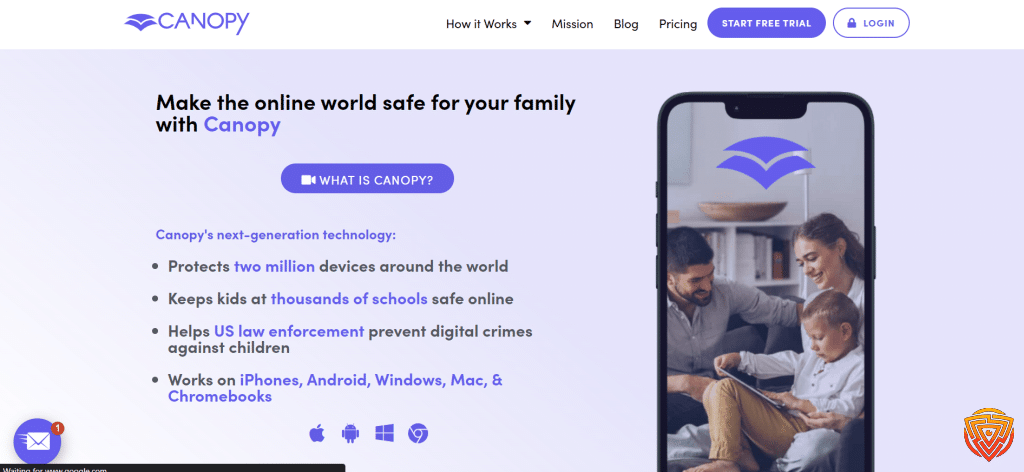
Best for: Families whose main priority is filtering explicit images and web content on a child’s Android phone.
Overview: Canopy is more specialised than Qustodio, Bark or Mobicip. Its central feature is real-time content filtering designed to identify and block supported explicit visual content while allowing the rest of a webpage to remain accessible.
The iPhone parent app or web dashboard can manage linked Android devices and supported settings. Canopy also includes app and website controls, downtime scheduling, location awareness and removal protection. However, it is primarily a filtering service rather than a complete activity-monitoring platform.
Key Features
- Real-time filtering of supported explicit web content
- App and website blocking
- Downtime and screen-time scheduling
- Location-awareness tools
- Removal prevention and device safeguards
Pros
- More specialised visual-content filtering than most general parental controls
- Works across iPhone, Android, computers and Chromebooks
- All family plans include the principal filtering features
Cons
- Does not provide Bark-style analysis across numerous conversations and connected accounts
- Activity reporting is not as broad as some general parental control suites
- Can be expensive if filtering is not the household’s main priority
Pricing: Canopy’s Individual plan costs $8.33 per month billed annually for up to three devices. Its Family plan costs $9.99 per month billed annually for up to ten devices. Both currently include a seven-day trial and a 30-day money-back guarantee.
Choose it if: content filtering is more important than detailed social-media or conversation monitoring.
Avoid it if: you primarily need detailed activity reports, connected-account alerts or advanced app schedules.
6. Wondershare FamiSafe: Best for Teen Location and Driving Features

Best for: Families with older children who prioritise location, geofencing and driving reports.
Overview: Wondershare FamiSafe combines standard parental controls with location and driving-safety functions. The iPhone parent app can manage a linked child Android phone, making it relevant when the parent and child use different mobile operating systems.
Its location history, geofencing and driving reports give FamiSafe a clearer use case for teenagers than products focused mainly on younger children’s screen time. It also offers screen-time schedules, website filtering and supported app restrictions. Android generally receives more of FamiSafe’s mobile feature set than iPhone.
Key Features
- Real-time location, location history and geofencing
- Driving reports for supported child devices
- Screen-time limits and schedules
- Website filtering and Safe Search tools
- Supported app blocking and activity information
Pros
- Strong combination of location, geofencing and driving features
- Supports a broad range of mobile and computer platforms
- Annual plan covers up to ten devices
Cons
- Feature availability still varies by Android version and device manufacturer
- Some advanced features may be unnecessary for routine family supervision
- Requires careful permission and battery configuration on the child device
Pricing: FamiSafe costs $59.99 per year for up to ten devices. The monthly plan costs $9.99 for up to five devices. A free version and a three-day trial of the annual plan are currently available, followed by a seven-day money-back guarantee.
Choose it if: location, geofencing and driving reports are important for supervising an older child.
Avoid it if: driving and detailed location features are not important to your family.
7. OurPact: Best for App Blocking and Schedules

Best for: Parents who want detailed app rules, recurring schedules and instant device pauses on Android.
Overview: OurPact specialises in controlling when mobile apps and device functions are available. Parents can build schedules for school, homework, family time and bedtime, create screen-time allowances, pause access and receive supported location alerts.
The iPhone parent app can manage linked iPhone and Android child devices. This makes OurPact one of the strongest options when the aim is to control an Android phone from iPhone through app rules and repeatable schedules rather than broad social-media analysis.
Key Features
- Recurring app-blocking and device schedules
- Daily screen-time allowances and instant lock
- New-app alerts and device safeguards
- Live location, location history and place alerts
- Screen snapshots and content alerts with Premium+
Pros
- Strong app-blocking and scheduling tools for Android
- Paid plans cover up to twenty child devices
- Good fit for structured school, homework and bedtime routines
Cons
- No Windows or Mac child-device coverage
- Premium+ is required for screenshots and content monitoring
- Narrower connected-account alert coverage than Bark
Pricing: OurPact Premium costs $6.99 per month or $69.99 per year for up to twenty child devices. Premium+ costs $9.99 per month or $99.99 per year. A limited free tier covers one child device, while new accounts receive trial access to paid features.
Choose it if: detailed Android app rules and schedules are more important than analysing conversations or connected social accounts.
Avoid it if: you need to manage child computers or want Bark-style connected-account alerts.
A Message-Supervision Alternative
MMGuardian is another option when a defined need for child-message supervision matters more than a broad general-purpose shortlist. Its Android and iPhone workflows differ substantially. Check the requirements below before considering it; detailed message access may be unnecessary for ordinary screen-time rules.
Scroll horizontally to see all columns.
| Product | Price and devices | Child devices | Main features | Important limitations |
|---|---|---|---|---|
 MMGuardian MMGuardianFull review | Single child: US$4.99/month or $49.98/year. Family: $9.99/month or $99.98/year for up to 5 child devices. Parent apps do not count. Check pricing | Android and iPhone app workflows; platform-specific setup and capabilities differ. | Message reports and safety alerts; app/web controls and location. Android supports SMS and selected social apps; iPhone supports SMS/iMessage and documented WhatsApp/Kik reports. | iPhone message reports require a computer Sync App and the same Wi-Fi network; no iPhone call/SMS blocking. Android SMS reporting requires MMGuardian as the default messaging app. Tablet-only licences are separate. |
How to Set Up Parental Control From iPhone to Android

The exact process varies by provider, but a normal setup follows these steps:
1. Decide Whether Google Family Link Is Enough
Start with Family Link if you mainly need screen-time limits, app approvals, Google Play restrictions and location. Google documents how parents can manage a child’s Android screen time and manage Google Play apps. Consider a paid service when you need broader website filtering, more detailed reports, safety alerts or one dashboard for several operating systems.
2. Install the Parent App on Your iPhone
Install Google Family Link or the provider’s official parent app from the App Store. Create the family account, add the correct child profile and protect the parent login with a unique password and multi-factor authentication where offered.
3. Link the Child’s Android Phone
Have the unlocked Android phone available. For Family Link, sign in with or add the supervised child Google Account and follow Google’s on-device instructions. For a paid service, install its official child app using the provider’s documented method, then enter the pairing code or sign in to link the correct child profile.
4. Grant Only the Required Android Permissions
Follow the provider’s instructions for location, notifications, usage access, web filtering, device administration and accessibility only where a chosen feature genuinely requires them. Review the permission prompts rather than approving them blindly. Avoid unofficial apps that ask you to disable core Android security protections without a clear, legitimate reason.
5. Start With a Small Set of Clear Rules
Set the essentials first: a bedtime schedule, an age-appropriate web filter, rules for distracting apps and the location alerts your family actually needs. Use our age-based parental control guidance to keep the rules proportionate. Too many restrictions at once can make faults harder to diagnose and may create unnecessary conflict.
6. Test Every Important Control
Use the child’s Android phone to confirm that blocked websites, schedules, app rules and location updates behave as expected. Check again after Android updates or a change to battery-saving settings because background permissions can change.
7. Explain the Setup to Your Child
Tell the child what is being filtered or reported, why each rule exists and when the controls will be reviewed. Transparent, age-appropriate supervision protects trust and makes it easier to relax restrictions as the child develops better judgement.
What iPhone-to-Android Parental Controls Can and Cannot Do
| Feature | What to Expect on Android |
|---|---|
| Screen-time schedules | Widely supported through Family Link and paid services; exact controls vary by Android version and provider. |
| App approvals and blocking | Family Link can manage supported Google Play apps; paid services may add schedules, categories or broader reporting. |
| Website filtering | Available through Family Link for supported Google services and through third-party filtering methods. |
| Location and geofencing | Usually available when device location, background access and the required permissions remain enabled. |
| Activity reports | Common for supported device, app and web activity; no service provides unrestricted visibility into every app. |
| Messages and social content | Coverage depends on the provider, Android version, app, installation method, connected account and country. |
| Unrestricted remote control | Not provided by ordinary parental control apps. Parents can apply supported rules, but they do not take unrestricted control of the phone. |
Do not use general remote-access or screen-sharing software as a substitute for parental controls. It does not provide the same family account protections, age-appropriate rules or clear child-device safeguards. A dedicated parental control service is the more proportionate choice for routine family supervision.
Google Family Link: The Best Free Starting Point

Family Link is unusually well suited to this exact pairing. Google supports the parent app on iPhone and supervision on compatible Android child devices. Parents can manage supported screen-time limits, app approvals, Google Play settings, Chrome and Search controls, account settings and location from the Family Link app.
Google says the parent must have an Android device, supported Chromebook or an iPhone or iPad running iOS 16 or later. The parent and child also normally need to live in the same country. Child-device eligibility and available settings vary by Android version. Google’s Family Link requirements should be checked before setup.
Its limits are equally important. Family Link is centred on Google’s ecosystem and does not provide every type of third-party web filter, cross-platform report or concerning-content alert. It can be sufficient for everyday Android rules, but it is not automatically the best fit for every family.
Compare the trade-offs in our guides to built-in parental controls vs paid apps and the best free parental control apps for Android.
How to Choose the Right Cross-Platform App

- Start with the child device: confirm Android support for every essential feature rather than relying on a general platform list.
- Decide between control and alerts: Qustodio and OurPact are stronger for rules and schedules; Bark is designed around safety alerts.
- Check setup requirements: confirm the required Android version, installation route, permissions and whether battery optimisation must be adjusted.
- Match the device allowance: compare the number of child devices, not just the headline monthly equivalent.
- Consider age and trust: younger children may need firmer app and time rules; older children may benefit from lighter, alert-based supervision. Our teenager parental control guide explains the trade-off in more detail.
- Use a trial carefully: test the exact Android features you need before the trial or refund window ends.
Troubleshooting Parental Control From iPhone to Android

- Rules do not apply: confirm the child is linked to the correct profile and that the required supervision or device-administrator setting remains active.
- Location stops updating: check location permission, background activity, mobile data and battery optimisation on the Android phone.
- Reports are incomplete: verify usage-access, accessibility or browser-filter permissions only where the provider officially requires them.
- The child changed phones: remove the retired device from the family dashboard and repeat the provider’s official setup on the replacement.
- Controls fail after an update: update both parent and child apps, review permissions and test one control at a time before reinstalling.
Responsible Use and Privacy
Use parental control software only on a child’s device that you own or are legally authorised to manage. Laws and expectations differ by country, the child’s age and the family arrangement. Separated or co-parenting households should agree who can access location and activity information.
Parental controls work best as one part of a family safety plan. Use the least intrusive settings that meet the need, protect the parent account, review access regularly and explain the rules in age-appropriate language. No app guarantees that every unsuitable site, message or behaviour will be detected.
Final Verdict
Qustodio is the best parental control app for managing a child’s Android phone from an iPhone for most families. It offers the most useful balance of cross-platform management, web filtering, time rules, reports and location tools without relying on unrestricted remote access.
Google Family Link is the best free starting point and may be all many households require. Bark is the better paid choice when alert-based online-safety monitoring is the priority. Mobicip is a strong mixed-device alternative, while OurPact is the specialist choice for detailed mobile app schedules.
Whichever service you choose, verify its current Android feature list and test the controls on the child’s phone before committing to a long subscription.
Frequently Asked Questions
How can I set up parental control from iPhone to Android?
Install Google Family Link or a compatible parent app on your iPhone. Add the child profile, link the child’s Android phone, grant the permissions required for your chosen features and test the screen-time, app, filtering and location rules. You normally need the unlocked Android phone during setup.
Can you control an Android phone from an iPhone?
Yes. Google Family Link and several third-party parental control apps let an iPhone-using parent manage supported rules on a child’s Android phone. They can apply parental controls, but they do not provide unrestricted remote control of the device.
What parental control app works between iPhone and Android?
Google Family Link, Qustodio, Bark, Mobicip, Norton Family, Canopy, FamiSafe and OurPact work between iPhone and Android in supported configurations. Family Link is the strongest free starting point; Qustodio is our best paid all-round option; and Bark is better for concerning-content alerts.
What is the best parental control app for Android from iPhone?
Qustodio is the best paid option for most families because it combines cross-platform screen-time rules, web filtering, app controls, reports and location features. Google Family Link is the better first choice when free Android screen-time, app and location controls are sufficient.
Is Google Family Link free on iPhone?
Yes. The Family Link parent app is free, and Google supports it on iPhone and iPad running the required iOS version. The child must use a compatible supervised Android device or Chromebook for full device-level supervision.
Can Apple Family Sharing control an Android phone?
No. Apple Family Sharing and Screen Time are designed for Apple devices and services. They do not provide Android app blocking, screen-time limits or device supervision. Use Google Family Link or a cross-platform parental control service instead.
Can I block Android apps from my iPhone?
Yes. Family Link can approve, block and set limits for supported Google Play apps on a supervised Android device. Paid cross-platform services may provide different app rules or schedules. System apps and exact controls vary by service and Android version.
Can I see my child’s Android location on my iPhone?
Yes, when location sharing and the required device permissions are enabled. Family Link and several paid services can show a supported Android device’s location in the iPhone parent app. Location can be delayed or unavailable if the device is offline, powered off or restricted by battery settings.
Do I need access to the child’s Android phone during setup?
Usually, yes. You generally need the unlocked Android phone to add or confirm the supervised account, install the official child app where required, link the device and approve permissions. Remote setup without authorised device access is not appropriate.
Can a child disable parental controls on Android?
No parental control is impossible to disrupt. Account age, Android version, permissions and manufacturer settings affect what the child can change. Protect the parent account, review device status regularly and use transparent family rules rather than relying on software alone.
Related Posts


Share this article

Stuart Kerr Spindlow is Impulsec’s Publisher, Chief Editor and Lead Reviewer. He writes and maintains coverage of consumer cybersecurity and digital-safety software, with a focus on practical suitability, limitations and the evidence behind product claims. Read Stuart’s full profile.