


The best child control app for most families is Qustodio. It combines screen-time schedules, web filtering, supported app controls, activity reports and location tools in one parent dashboard, with support for a broad range of family devices.
It is not the right choice for every child. Bark is better for behaviour-based safety alerts, Mobicip suits mixed-device households, and OurPact is particularly useful for mobile app blocking and repeatable routines. The strongest option depends on the child’s age, the devices being managed and the specific problem you need to solve.
Quick verdict: Choose Qustodio for the strongest overall balance of everyday controls. Choose Bark for safety alerts involving an older child, Mobicip for mixed devices, Norton Family for a large household, Canopy for specialised content filtering, FamiSafe for teen location and driving features, or OurPact for detailed mobile schedules.
Best Child Control Apps at a Glance
- Qustodio: Best overall child control app
- Bark: Best for behaviour-based safety alerts
- Mobicip: Best for mixed-device family management
- Norton Family: Best for large families and existing Norton users
- Canopy: Best for specialised explicit-content filtering
- Wondershare FamiSafe: Best for teen location and driving features
- OurPact: Best for mobile app blocking and schedules
No third-party service has identical access on every operating system. Apple restricts some forms of app, message and activity visibility on iPhone, while Android features can depend on permissions, installation method and device manufacturer. Confirm that the feature you need works on the child’s device before paying.
Child Control App Comparisons
The Core 7 table compares pricing structure, device allowances, free plans or trials, principal features, suitable use cases, important limitations and supported platforms. Use it as a shortlist rather than assuming the highest-ranked app is automatically right for every family.
| Software | Pricing (Devices) | Free Plan / Trial | Key Features | Best For | Key Limitation | Supported Platforms | Review |
|---|---|---|---|---|---|---|---|
 🏆 Qustodio (Editor’s Choice)Read Qustodio Review 🏆 Qustodio (Editor’s Choice)Read Qustodio Review | Basic: US$59.95/year, 5 devices; Complete: US$104.95/year, family devices subject to terms. Check Qustodio Pricing | Check current free/trial eligibility during signup. | 🕒 Screen-time limits and schedules 🌐 Web and app filtering 📍 Location monitoring 📊 Activity reports | Editorial all-round pick for everyday controls and reporting; not a measured test winner. | Calls and messages on iOS require a Windows or Mac computer; other features vary by platform. | 🪟 Windows, 🍎 macOS, 📱 iOS, 🤖 Android, Chromebook, Kindle Fire | Read Qustodio Review |
 BarkRead Bark Review BarkRead Bark Review | Bark App: from US$14/month; unlimited devices and accounts. Phone and Watch are separate products. Check Bark Pricing | 7-day app trial; check signup terms. | 🚨 Concerning-content alerts 💬 Text, email and social-app monitoring 🕒 Screen-time schedules 🌐 Website and app blocking | Best for behaviour-based safety alerts without routinely exposing every conversation | Check country availability and exact account/device coverage; Bark App, Phone and Watch have different capabilities. | iOS and Android app; other devices and connected services depend on the monitoring feature. | Read Bark Review |
 MobicipRead Mobicip Review MobicipRead Mobicip Review | Lite: US$2.99/month for 5 devices; Standard: US$4.99 for 10; Premium: US$7.99 for 20. All billed annually. Check Mobicip Pricing | 7-day Premium trial; check cancellation/refund terms. | 🌐 Website and app blocking 🕒 Screen-time schedules 📍 Family location 📊 Activity and social-media reports | Best for mixed-device families wanting flexible device allowances | Check plan and platform support for each required feature; a supported device does not have every control. | 🪟 Windows, 🍎 macOS, 📱 iOS, 🤖 Android, Chromebook, Kindle Fire | Read Mobicip Review |
 Norton FamilyRead Norton Family Review Norton FamilyRead Norton Family Review | US$49.99 for the first year; check renewal price. Included with selected Norton 360 subscriptions. Check Norton Family Pricing | Check current trial availability in your country. | 🌐 Web, search and video supervision 🕒 Time limits and schedules 📍 Location history and alerts 📊 Email activity reports | Best for large families and households already using Norton | A Mac can manage Norton Family but cannot be monitored as a child device; features differ across platforms | 🪟 Windows, 📱 iOS, 🤖 Android | Read Norton Family Review |
 CanopyRead Canopy Review CanopyRead Canopy Review | Essential: US$8.33/month for 1 device; Plus: US$9.99 for 3; Premium: US$12.50 for up to 10. All billed annually. Check Canopy Pricing | 7-day trial; 30-day guarantee subject to terms. | 🌐 Real-time content filtering 🖼️ Sensitive-image detection 🚫 App and website blocking 🕒 Screen-time management | Best for filtering explicit images and web content | Check coverage for the particular app/browser and device; filtering is not a guarantee that every risk is detected. | 🪟 Windows, 🍎 macOS, 📱 iOS, 🤖 Android, Chromebook | Read Canopy Review |
 Wondershare FamiSafeRead FamiSafe Review Wondershare FamiSafeRead FamiSafe Review | US$59.99/year for up to 10 devices, or US$9.99/month for up to 5 devices. Check FamiSafe Pricing | 3-day annual-plan trial; 7-day money-back guarantee subject to terms. Free tier has restricted/demo features. | 📍 Location and geofencing 🚗 Driving reports 🚫 App and website controls 🕒 Screen-time schedules | Best for families with teenagers and driving-safety needs | Advanced visibility features are platform-specific and should be used transparently with older children | 🪟 Windows, 🍎 macOS, 📱 iOS, 🤖 Android, Chromebook, Kindle Fire | Read FamiSafe Review |
 OurPactRead OurPact Review OurPactRead OurPact Review | Premium: US$69.99/year; Premium+: US$99.99/year. Both cover up to 20 child devices. Check OurPact Pricing | Trial offered; confirm duration and cancellation terms during signup. | 📱 Detailed app rules 🕒 Screen-time schedules and allowances 📍 Live location and location alerts 📸 Screen snapshots with Premium+ | Best for app blocking and detailed schedules across iPhone and Android | Limited to mobile devices; Premium+ is required for screenshots and content monitoring, and initial pairing may require a computer | 📱 iOS, 🤖 Android | Read OurPact Review |
Fastest way to choose: List the phones, tablets and computers the child uses. Decide whether your priority is screen-time routines, app restrictions, web filtering, safety alerts or location. Remove any product whose key feature is unavailable on that device or plan.
Our Top 7 Child Control App Reviews
These mini reviews follow the same order as the Core 7 table. Each one explains the app’s strongest use case, the limitation most likely to rule it out and the type of family it suits.
1. Qustodio: Best Overall Child Control App

Best for: Families wanting one well-rounded service for screen time, filtering, app rules, reports and location across several device types.
Why it ranks first: Qustodio provides the best overall balance of routine controls and family visibility in this comparison. Its parent dashboard brings together daily limits, schedules, web filtering, supported app controls, activity information and location tools without requiring a separate service for each task.
Its broad device support is especially useful when a child moves between a phone, tablet and computer. The different paid device allowances also make it easier to match the subscription to the household, while the limited free plan provides a starting point for basic use.
What Qustodio Does Well
- Combines screen-time rules, web filtering and supported app controls
- Provides location information and family activity reports
- Supports more child-device types than mobile-only alternatives
- Offers a limited free plan and paid plans for different family sizes
Important limitation: Calls and message monitoring is Android-only, and other functions also vary by platform. An iPhone household should not assume that every Android feature is available on iOS.
Choose Qustodio if: you want the strongest all-rounder for consistent rules across several family devices.
Consider another app if: alerts about potentially concerning supported conversations are more important than detailed device rules; Bark is designed more directly for that purpose.
2. Bark: Best for Behaviour-Based Safety Alerts

Best for: Parents of older children who prefer targeted alerts about potentially concerning supported activity instead of routinely reviewing everything available.
Why it ranks second: Bark takes a different approach from a conventional child phone control app. It analyses supported texts, emails, social accounts and online activity for possible safety concerns, then alerts the parent when something may require attention. This can support a more proportionate form of supervision for an older child.
Bark also provides screen-time schedules, website and app blocking, and location functions. However, its main reason to subscribe remains its alert-based coverage rather than highly granular schedules or identical control over every device.
What Bark Does Well
- Provides alerts for potentially concerning supported content
- Covers selected texts, email and connected social accounts
- Includes website blocking, screen-time routines and location tools
- Focuses attention on possible concerns rather than constant manual checking
Important limitation: Bark is available only in supported countries, and coverage differs substantially by the child’s device and connected account. Pricing can also depend on whether the child uses Android or iPhone.
Choose Bark if: you want risk-focused alerts and are comfortable using a lighter-touch approach with an older child.
Consider another app if: you need detailed app-by-app schedules, broad international availability or the same functionality on iPhone and Android.
3. Mobicip: Best for Mixed-Device Family Management

Best for: Families managing a mixture of iPhone, Android, Windows, Mac and Chromebook devices.
Why it ranks third: Mobicip is designed for households that want similar family rules across several operating systems. Its dashboard brings together website filtering, screen-time schedules, supported app restrictions, location tools and activity information.
The paid plans cover different numbers of devices, which helps households avoid paying for far more coverage than they need. Mobicip is a practical alternative to Qustodio when mixed-device management and flexible allowances matter more than deeper reporting.
What Mobicip Does Well
- Supports mobile devices, computers and Chromebooks
- Provides web filtering and structured screen-time schedules
- Includes supported app controls, location and activity reports
- Offers plan sizes suited to different households
Important limitation: Social-media coverage is narrower than Bark’s alert-based monitoring, and some functions require a higher plan. Apple restrictions also mean iPhone controls differ from Android controls.
Choose Mobicip if: one child uses several device types or the family needs one dashboard for different operating systems.
Consider another app if: advanced safety alerts or highly detailed activity reporting are the main reason you are subscribing.
4. Norton Family: Best for Large Families and Norton Users

Best for: Larger households and families already paying for an eligible Norton plan that includes parental controls.
Why it ranks fourth: Norton Family stands out because it does not impose a small device allowance. This can offer strong value when several children use supported phones, tablets or Windows computers, especially when the service is already included in the household’s Norton subscription.
Its strongest functions focus on web activity, time rules, search supervision, location and parent reports. It is therefore better suited to broad family oversight than detailed control over every installed mobile app.
What Norton Family Does Well
- Covers unlimited supported devices
- May already be included with an eligible Norton subscription
- Provides useful web, time, search and location supervision
- Offers parent activity reports and summaries
Important limitation: Supervision is less extensive on iPhone than Android, and a Mac cannot be monitored as a child device. Some iPhone web functions also require additional configuration.
Choose Norton Family if: you need to cover many supported devices or already have an eligible Norton subscription.
Consider another app if: Mac child-device support or detailed iPhone app management is essential.
5. Canopy: Best for Specialised Content Filtering
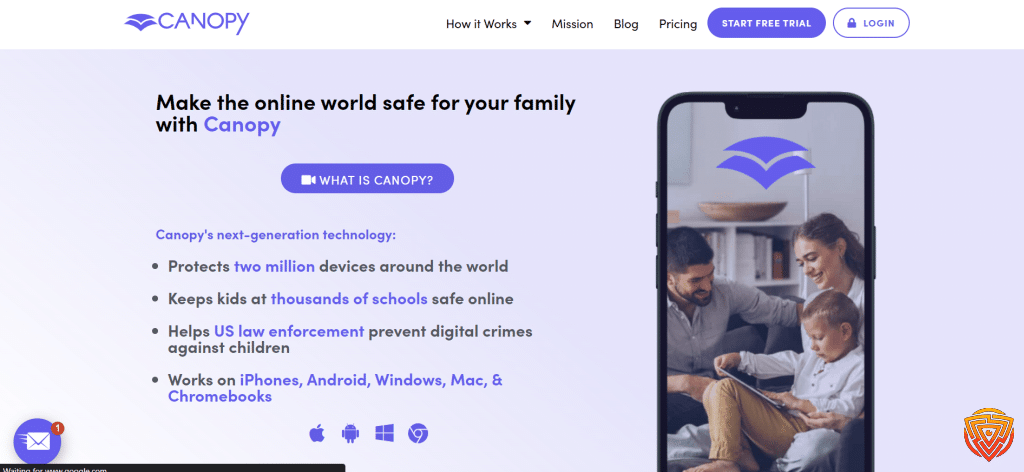
Best for: Families whose main priority is filtering explicit images and supported web content.
Why it ranks fifth: Canopy is more specialised than Qustodio, Bark or Mobicip. Its central feature is real-time filtering designed to identify and block supported explicit visual content while allowing the rest of a webpage to remain accessible where possible.
It also includes app and website controls, downtime scheduling, location awareness and removal safeguards. However, it is primarily a filtering product rather than a complete activity-reporting or conversation-alert platform.
What Canopy Does Well
- Provides specialised visual-content filtering
- Includes app and website controls plus downtime schedules
- Works across mobile devices, computers and Chromebooks
- Includes location and device-removal safeguards
Important limitation: Canopy does not provide Bark-style analysis across numerous conversations and connected accounts, and its general activity reporting is narrower than some full parental-control suites.
Choose Canopy if: specialised explicit-content filtering is more important than broad activity monitoring.
Consider another app if: you primarily need detailed reports, connected-account alerts or advanced app-by-app schedules.
6. Wondershare FamiSafe: Best for Teen Location and Driving Features

Best for: Families with older children who prioritise location, geofencing and supported driving reports.
Why it ranks sixth: FamiSafe combines standard device rules with location and driving-safety functions. Its location history, geofencing and supported driving reports give it a clearer use case for teenagers than products focused mainly on younger children’s screen time.
FamiSafe also provides schedules, website filtering and supported app restrictions. However, feature availability varies substantially by platform, and parents should not assume the deeper Android functions work in the same way on iPhone.
What FamiSafe Does Well
- Combines location history, geofencing and supported driving reports
- Provides screen-time limits and schedules
- Includes website filtering and Safe Search tools
- Supports a broad range of mobile and computer platforms
Important limitation: Several advanced monitoring and app-control features are unavailable or restricted on iPhone. Platform differences are important enough that the child’s exact device should be checked first.
Choose FamiSafe if: location, geofencing and driving information are central to supervising an older child.
Consider another app if: you need the same controls on iPhone and Android or want the strongest cross-platform routine management.
7. OurPact: Best for Mobile App Blocking and Schedules

Best for: Parents who want detailed mobile app rules, recurring schedules and instant device pauses.
Why it ranks seventh: OurPact specialises in controlling when mobile apps and device functions are available. Parents can build routines for school, homework, family time and bedtime, provide daily allowances, pause access and receive supported location alerts.
This makes OurPact a strong child control app when structured mobile routines are more important than broad computer support or connected social-account analysis. Its paid plans also cover a relatively large number of child devices.
What OurPact Does Well
- Provides recurring app-blocking and device schedules
- Includes daily allowances and instant device pauses
- Supports location history and place alerts
- Paid plans cover many mobile child devices
Important limitation: OurPact supports mobile child devices rather than computers. Full iPhone pairing also requires OurPact Connect on a Windows or Mac computer, and the higher plan is needed for its more advanced visibility features.
Choose OurPact if: app rules, recurring schedules and structured mobile routines are your priorities.
Consider another app if: you need to manage child computers or do not want to use a computer for full iPhone pairing.
Other Child Control Apps We Considered

The seven apps above are our main recommendations for everyday child-device management. The alternatives below may still suit narrower requirements, but they missed the Core 7 because of more limited platform support, regional restrictions, a specialist purpose or a weaker fit for most households.
| Software | Pricing (Devices) | Free Plan / Trial | Key Features | Best For | Key Limitation | Supported Platforms | Review |
|---|---|---|---|---|---|---|---|
 KidsloxRead Kidslox Review KidsloxRead Kidslox Review | Pricing varies by plan, region and app store; paid accounts support up to 10 devices; Check Kidslox Pricing | Free plan plus 3-day Premium trial | 🕒 Screen-time limits and schedules 🚫 Individual app blocking 🌐 Web filtering 📍 Location tracking | Best mobile-focused alternative for screen-time and app controls | No Windows, Mac or Chromebook child-device support; monitoring depth and app controls vary between iOS and Android | 📱 iOS, 🤖 Android | Read Kidslox Review |
 Boomerang Parental ControlRead Boomerang Review Boomerang Parental ControlRead Boomerang Review | $19.99/year for 1 Android child device or $39.99/year for up to 10 Android devices; Check Boomerang Pricing | 14-day free trial on Android and iOS child devices | 🕒 Flexible screen-time controls 📱 App approval and blocking 🌐 SPIN Safe Browser 📍 Location tracking | Best budget alternative for Android families | Most paid features and licences are Android-focused; iOS functionality is considerably more limited | 🤖 Android; limited 📱 iOS support | Read Boomerang Review |
 FamilyTimeRead FamilyTime Review FamilyTimeRead FamilyTime Review | $29/year for 1 child device; $49/year for 3 devices; $69/year for 5 devices; Check FamilyTime Pricing | 3-day trial; billing terms vary by purchase route | 📍 Location monitoring and geofencing 🕒 Screen-time schedules 🚫 App and website controls 🆘 SOS and family alerts | Best for mobile location features combined with screen-time rules | Feature depth varies substantially between Android and iPhone; communication-monitoring tools require transparent, lawful use | 📱 iOS, 🤖 Android | Read FamilyTime Review |
 OhanaReview Coming Soon OhanaReview Coming Soon | Currently $49.99/year; regional and app-store pricing may vary; Check Ohana Pricing | Free version plus 7-day trial of Ohana Plus | 🕒 Screen-time schedules 🚫 App blocking 🌐 Web filtering 📊 Family routines and usage insights | Promising alternative for families prioritising healthier screen-time routines | A newer product with less independent comparative evidence and no completed Impulsec review | 📱 iOS, 🤖 Android | Review Coming Soon |
 Aura Parental ControlsRead Aura Parental Controls Review Aura Parental ControlsRead Aura Parental Controls Review | Kids plan $10/month billed annually or $13/month billed monthly for unlimited children and devices; Family plan from $32/month billed annually; Check Aura Pricing | 14-day free trial; 60-day money-back guarantee on annual plans | 🌐 Content filtering and site blocking 🕒 Screen-time limits 🎮 Gaming-safety alerts 🔐 Identity and cybersecurity features on the Family plan | Best for US families wanting parental controls combined with identity and cybersecurity protection | Available only to US customers; considerably more expensive than a standalone parental-control app | 📱 iOS, 🤖 Android; Windows gaming protection on supported plans | Read Aura Parental Controls Review |
 Life360Read Life360 Review Life360Read Life360 Review | Free plan; Silver $7.99/month; Gold $14.99/month; Platinum $24.99/month in the US; Check Life360 Pricing | Free plan plus 7-day trial on paid plans | 📍 Live family location sharing 🗺️ Place and arrival alerts 🚗 Driving reports 🆘 Crash detection and emergency features on supported plans | Best specialist alternative for family location and teen-driving safety | Not a complete parental-control suite; it does not replace web filtering, app blocking or screen-time controls | 📱 iOS, 🤖 Android | Read Life360 Review |
 Net NannyRead Net Nanny Review Net NannyRead Net Nanny Review | $39.99/year for 1 computer; $54.99/year for 5 devices; $89.99/year for 20 devices; Check Net Nanny Pricing | No free trial currently stated | 🌐 Dynamic web filtering 🚫 Website and app blocking 🕒 Screen-time management 📊 Activity reports | Legacy alternative for compatible Windows and iOS households | No Android or Chromebook support; official Mac compatibility stops at macOS 11, making it unsuitable for current Macs | 🪟 Windows 10/11, 📱 iOS 11+, older 🍎 macOS 10.13–11 | Read Net Nanny Review |
Important distinction: Life360 is primarily a family location and driving-safety service rather than a complete child control app. Aura is restricted to US customers and bundles parental controls with broader identity and cybersecurity services. Net Nanny has significant current platform limitations. Those products should not be treated as direct substitutes for every Core 7 app.
What Is a Child Control App?

A child control app is parental-control software that lets a parent or guardian apply age-appropriate rules to a child’s phone, tablet or computer. Depending on the product and device, those rules can include screen-time limits, app access, website filtering, location features, activity reports and safety alerts.
The term describes the same general product category as a parental control app. In this guide, the emphasis is on practical day-to-day management: bedtime routines, homework periods, app approvals, suitable web access and proportionate supervision as the child becomes more independent.
What These Apps Can Do
- Manage time: set daily allowances, bedtime, school hours and device-free periods
- Control access: approve, block or schedule supported apps and websites
- Support safer browsing: apply filters, Safe Search settings and age-appropriate content rules
- Provide visibility: show activity summaries, location information or alerts where supported
- Coordinate rules: manage several children or devices from one parent account
What They Cannot Guarantee
No app can guarantee that a child never encounters unsuitable material, never creates a second account or never finds a workaround. Device controls are one part of family digital safety. They work best alongside clear expectations, regular conversations, secure parent credentials and rules that change with the child’s age.
How to Choose the Right Child Control App

1. Start With the Child’s Devices
Compatibility is the first filter. Record every child device you need to manage, including its operating system and version. An app that works well on Android may provide fewer controls on iPhone. Some services support Windows and Mac but not Chromebook, while mobile-only products cannot manage computers at all.
For platform-specific comparisons, use the dedicated guides to the best parental control apps for Android and the best parental control apps for iPhone.
2. Define the Main Job
Avoid paying for the longest feature list. Identify the one or two outcomes that matter most:
- Everyday screen-time and web rules: start with Qustodio or Mobicip
- Safety alerts for an older child: consider Bark where supported
- Large household coverage: compare Norton Family with the device allowances in Table 1
- Specialised explicit-content filtering: consider Canopy
- Teen location and driving information: compare FamiSafe with specialist Life360
- Mobile app schedules: consider OurPact
3. Match the Controls to the Child’s Age
Younger children generally benefit from simple rules, app approvals, web filtering and consistent routines. Older children may need more flexible schedules, location agreements or targeted safety alerts. Supervision should become more transparent and proportionate as independence grows.
The parental control apps by age guide explains how priorities can change between younger children and teenagers.
4. Check the Exact Plan
Do not assume every advertised feature is included in the cheapest plan. Compare the annual cost, device allowance, trial or refund terms, and the plan level needed for the feature you want. Pricing can also vary by country, currency, billing route and app store.
5. Review Privacy and Account Security
A child control service may process sensitive information such as browsing activity, app usage and location. Read the provider’s current privacy information, protect the parent account with a unique password and multi-factor authentication where offered, and remove old child devices from the account when they are no longer managed.
Built-In Controls vs a Paid Child Control App
Built-in tools may be enough when the family uses one ecosystem and needs basic rules. Apple Screen Time can manage supported app limits, downtime, purchases and content settings across a Family Sharing group. Google Family Link provides app approvals, time rules, content settings and location features for supported Android and Chromebook devices.
A paid child control app becomes more useful when you need one dashboard for mixed devices, more detailed reports, advanced filtering, specialised alerts, geofencing or stronger scheduling. The trade-off is an ongoing subscription and the need to share more family data with a third-party provider.
| Choose Built-In Controls If | Choose a Paid App If |
|---|---|
| Your family mainly uses Apple devices or mainly uses Google-supported devices | Your household mixes iPhone, Android, computers or Chromebooks |
| You need basic time limits, app approvals and purchase controls | You need detailed schedules, reporting, filtering or location features |
| You want to avoid another subscription | The additional functions justify an annual cost |
| You are comfortable managing separate ecosystems | You want one parent dashboard across several device types |
Best Free Child Control Apps

Free options can be sufficient for app approvals, basic screen-time limits and simple content settings. They are usually strongest when the parent and child stay within the same device ecosystem. They become less suitable when the household needs mixed-device management, deeper reporting or specialist alerts.
This master table compares genuine free parental-control plans and built-in family-safety tools. Individual articles may display only the rows relevant to that platform. Features and child-device compatibility vary by platform and region.
| App | Pricing / Paid Upgrade | Free Access | Key Features | Main Free Limitation | Best For | Child Devices Supported | Review |
|---|---|---|---|---|---|---|---|
| Qustodio FreeRead Qustodio Review | Free for 1 child device; paid plans from $59.95/year; 👉 Check Qustodio Pricing | ✔️ Permanent limited free plan | 🌐 Web filtering and Safe Search ⏸️ Restricted times and pause internet 📊 7-day activity reports 📱 Protection for 1 child device | Limited to 1 device; daily time allowances, app blocking, location and advanced monitoring require a paid plan | Best free third-party dashboard with a clear paid upgrade path | Android, iOS, Windows, macOS, Chromebook and Kindle | Read Qustodio Review |
| OurPact FreeRead OurPact Review | Free starter tier; Premium from $6.99/month or $69.99/year; 👉 Check OurPact Pricing | ✔️ 1 child device 5 manual blocks per month 1 automated schedule Web-browser blocking | 🚫 Manual app and device blocking ⏱️ One automated block schedule 🌐 Web-browser blocking 📱 Management of 1 child device | Only 5 manual blocks per month and 1 automated schedule; most controls require Premium | Best simple free screen-time and blocking starter tool for one phone | Android and iOS | Read OurPact Review |
 Kaspersky Safe Kids FreeRead Kaspersky Safe Kids Review Kaspersky Safe Kids FreeRead Kaspersky Safe Kids Review | Free version available; paid plans and prices vary by region; 👉 Check Kaspersky Pricing | ✔️ Permanent free version with basic features | 🌐 Internet monitoring and website blocking 📱 Device-use monitoring 🖥️ App management 🔎 Basic activity visibility | Premium reporting, location and alerts are excluded; availability varies by country | Best free web filtering option where Kaspersky remains available; not recommended for US users | Android, iOS, Windows and macOS; features differ by platform | Read Kaspersky Safe Kids Review |
 Google Family LinkRead Google Family Link Review Google Family LinkRead Google Family Link Review | Free; Open Guide | ✔️ Completely free | 📱 App approvals and blocking 🕒 Screen-time limits 📍 Device location 🔎 Google Account supervision | Does not supervise a child’s iPhone or iPad; its main controls are for Google platforms | Best completely free parental control for Android and Chromebook families | Android and Chromebook child devices; parent app available on Android and iOS | Read Google Family Link Review |
 Apple Screen TimeRead Apple Screen Time Review Apple Screen TimeRead Apple Screen Time Review | Free and built into Apple devices; Open Guide | ✔️ Completely free | ⏱️ App limits and downtime 🔒 Content and purchase restrictions 📊 App and website activity summaries 👪 Family Sharing controls | Restricted to the Apple ecosystem; less suitable for mixed-device families | Best completely free parental controls for iPhone, iPad and Mac | iPhone, iPad and Mac | Read Apple Screen Time Review |
 Microsoft Family SafetyRead Microsoft Family Safety Review Microsoft Family SafetyRead Microsoft Family Safety Review | Free basic family-safety features; some benefits require Microsoft 365 Family; Open Guide | ✔️ Free basic family-safety features | ⏱️ Screen-time and app limits on supported devices 📊 Activity reports 🌐 Microsoft Edge content filtering 🎮 Windows and Xbox integration | Does not provide device-level control over a child’s iPhone; web filtering depends heavily on Microsoft Edge | Best for Windows, Xbox and Microsoft-centred households | Windows and Xbox; Android app and game limits; iOS parent-management app only | Read Microsoft Family Safety Review |
 Samsung KidsReview Coming Soon Samsung KidsReview Coming Soon | Free and built into supported Samsung Galaxy devices; Open Guide | ✔️ Completely free on supported Samsung devices | 🧒 Child-friendly interface 🔒 Approved apps and content ⏱️ Usage controls 📊 Activity information | A local child environment rather than a full remote parental-control service | Best built-in child mode for younger children using Samsung devices | Supported Samsung Galaxy phones and tablets | Review Coming Soon |
 Amazon KidsReview Coming Soon Amazon KidsReview Coming Soon | Free parental tools; optional Amazon Kids+ content subscription; Open Amazon Kids | ✔️ Free parental tools; Kids+ is optional | ⏱️ Daily time limits 📚 Educational goals 🔒 Content and age filters 👧 Child profiles | Designed mainly around Amazon devices and services; Kids+ content requires a subscription | Best free parental controls for Amazon Fire tablets and devices | Fire tablets, Kindle e-readers, Echo and supported Amazon devices | Review Coming Soon |
Best free starting points: Google Family Link is generally the strongest option for supported Android and Chromebook families. Apple Screen Time is the natural starting point for iPhone and iPad households. Limited free tiers from paid providers can help parents assess an interface, but they should not be mistaken for the full paid service.
If an iPhone household wants to avoid a subscription, compare the dedicated free parental control options for iPhone.
Privacy, Transparency and Responsible Use

Parental controls should be used for lawful, age-appropriate family supervision on devices a parent or guardian is authorised to manage. They should not be used to monitor a partner, another adult or someone else’s account or device without clear authority and consent.
Where practical, explain what the app can see, why each rule exists and when it will be reviewed. Younger children may need firmer restrictions. Older children generally benefit from clearer boundaries and greater involvement in setting the rules. Transparency supports trust and makes it easier to reduce controls as responsibility grows.
Use the Minimum Visibility Needed
More monitoring is not automatically better. If app limits and web filtering solve the problem, there may be no need to collect detailed communications data. Enable only the functions needed for the child’s age and circumstances, and review permissions regularly.
Protect the Parent Account
- Use a unique password that the child does not share
- Turn on multi-factor authentication where available
- Keep parent and child accounts separate
- Review linked devices and permissions after operating-system updates
- Remove the service when supervision is no longer required
Can a Child Bypass a Child Control App?
No provider can truthfully guarantee that its app can never be removed or bypassed on every device. Common problems include missing permissions, guessed parent passwords, unmanaged secondary devices, alternate browsers, new accounts and changes introduced by operating-system updates.
Parents can reduce routine workarounds by using a separate parent password, keeping the child on a non-administrator account where appropriate, enabling supported tamper alerts and checking the parent dashboard periodically. The aim should be reliable family rules, not invisible or excessive surveillance.
How We Ranked the Core 7
The ranking prioritises suitability for lawful family use rather than the longest feature list or the highest affiliate commission. We considered:
- Routine controls: screen time, schedules, web filtering and supported app rules
- Platform coverage: whether the service supports the devices families actually use
- Platform limitations: especially differences between Android and iPhone
- Age suitability: whether the approach fits younger children, teenagers or both
- Family value: annual pricing structure, device allowance and the usefulness of the included plan
- Privacy and responsible use: whether the product can be positioned transparently for authorised family supervision
- Distinctive strength: the specific family need the product handles better than its alternatives
Product features, pricing and compatibility can change. The tables summarise the current published plan structure, but parents should confirm the exact device and feature on the provider’s official page before subscribing.
Final Verdict
Qustodio is the best child control app for most families because it offers the strongest overall balance of screen-time management, filtering, supported app rules, activity reports, location and broad device compatibility.
Choose a more specialised option when the family’s main need is different. Bark is stronger for behaviour-based alerts involving an older child, Mobicip is a practical mixed-device alternative, Norton Family suits large households, Canopy focuses on explicit-content filtering, FamiSafe emphasises teen location and driving features, and OurPact is especially useful for mobile app schedules.
Start with the devices and the main family rule you need to enforce. Then choose the least intrusive service that handles that requirement reliably. For a broader category comparison, see the best parental control app guide.
Frequently Asked Questions
What is the best app to control your child’s phone?
Qustodio is the best app to control a child’s phone for most families because it combines screen-time schedules, web filtering, supported app controls, reports and location tools with broad device support. A specialist option may be better when alerts, content filtering or mobile schedules are the main priority.
Can I control my child’s phone from my phone?
Yes. Most child control apps provide a parent app or web dashboard for changing time limits, schedules, supported app rules and other settings remotely. The available controls depend on the parent device, child device, operating system and permissions.
What is the best free child control app?
Google Family Link is the strongest free starting point for many supported Android and Chromebook families. Apple Screen Time is the natural built-in free option for iPhone and iPad. Both are most effective within their own ecosystems.
Do child control apps work on iPhone and Android?
Many services support both, but they rarely provide identical features. Apple restricts some third-party app, message and activity visibility on iPhone, while Android functions can depend on permissions and installation method. Check the exact feature for the child’s device before paying.
Can a child control app block apps and limit screen time?
Yes. Most leading services can set daily limits, create schedules, pause access and block or restrict supported apps. The level of app control varies by operating system, and some advanced functions require a higher paid plan.
Can a child control app read text messages?
Some services can analyse or report supported message activity, but coverage depends on the product, operating system, permissions, country and setup method. Message-related functions are generally broader on Android than iPhone and should be used transparently and lawfully.
Are built-in parental controls enough?
Built-in controls can be enough for basic screen time, app approvals, purchases and content settings within one ecosystem. A paid app is more useful for mixed-device management, detailed reporting, specialist alerts, geofencing or stronger schedules.
Can a child delete a child control app?
No app is impossible to remove on every device. Correct permissions, a separate parent password, non-administrator child accounts and supported tamper alerts can make removal harder, but families should also use clear rules and review settings regularly.
How can I see everything on my child’s phone?
No legitimate child control app can guarantee complete visibility into everything on every phone. Access varies by operating system, permissions, app, plan and setup method, with iPhone generally allowing less third-party visibility than Android. Use only the minimum monitoring needed for age-appropriate, authorised family supervision.
Is Life360 or Bark better?
Bark is better when the priority is alerts about potentially concerning supported messages, email and online activity. Life360 is better for family location sharing, place alerts and supported driving-safety features. Life360 is not a complete replacement for Bark or a full parental-control suite.
Related Posts


Share this article

Stuart Kerr Spindlow is Impulsec’s Publisher, Chief Editor and Lead Reviewer. He writes and maintains coverage of consumer cybersecurity and digital-safety software, with a focus on practical suitability, limitations and the evidence behind product claims. Read Stuart’s full profile.